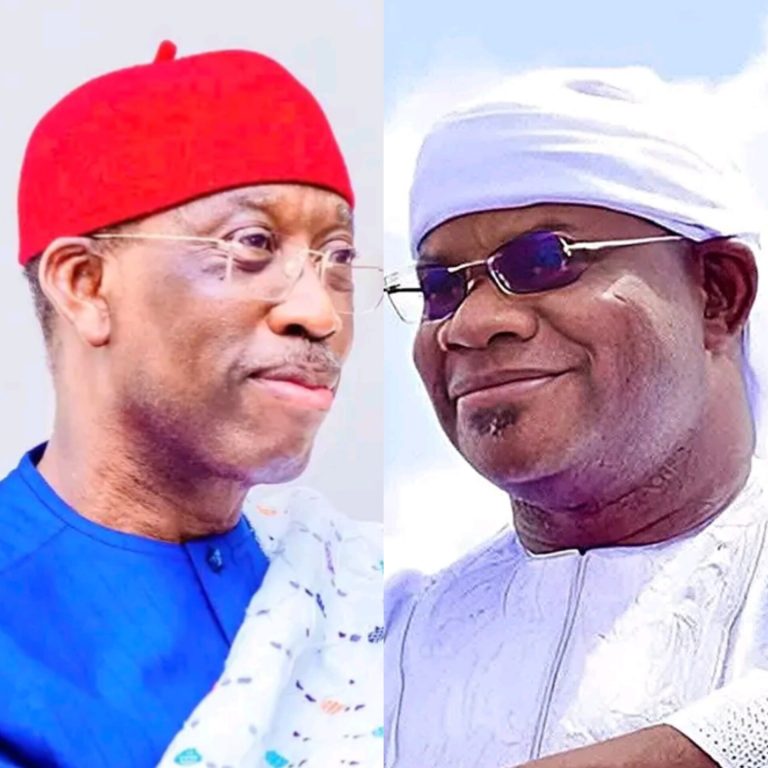
EFCC, Senator Ifeanyi Okowa and Yahaya Bello
Nigeria’s anti-corruption war stands today at a defining crossroads. More than ever before, Nigerians are asking whether the fight against corruption is truly guided by the rule of law or by political convenience.
The handling of the Economic and Financial Crimes Commission (EFCC) investigations involving former Delta State Governor, *Senator Ifeanyi Okowa,* and former Kogi State Governor, *Senator Yahaya Bello,* has become a litmus test for the credibility of Nigeria’s justice system.
No civilized democracy can effectively wage war against corruption if justice is perceived to be selective. The Constitution guarantees equality before the law and the presumption of innocence. These principles must remain sacrosanct.
However, constitutional safeguards should never become an excuse for endless delays in prosecuting high-profile cases after serious allegations have already been made public.
The EFCC has publicly alleged that Senator Ifeanyi Okowa is connected with the diversion of approximately ₦1.3 trillion in Delta State funds. Senator Yahaya Bello is also facing allegations in separate criminal cases involving approximately ₦80.2 billion and ₦110.4 billion. These remain allegations which only the courts can determine. Yet, the magnitude of the allegations raises legitimate public concerns about the pace of the judicial process.
The disturbing questions therefore remain.
*Why has the prosecution of these cases not been concluded with the urgency expected in matters of such national importance?*
*Why should investigations involving allegations of this magnitude linger while the individuals concerned continue to participate in active partisan politics?*
*Why should persons facing unresolved allegations of financial crimes be presented as candidates for the Senate of the Federal Republic of Nigeria before these matters are judicially determined?*
*Why was every effort not made to conclude these cases before party nominations?*
*Why should Nigerians continue to hear about investigations without seeing timely judicial resolution?*
*Why should the anti-corruption agency publicly announce the outcome of investigations if the cases cannot proceed expeditiously through the courts?*
*Why does the law appear to move at different speeds depending on who is involved?*
These questions deserve honest answers.
The issue extends beyond two individuals. It concerns the integrity of Nigeria’s institutions. Public office is a sacred trust. The Senate is one of the highest legislative institutions in the country.
Any attempt by persons facing unresolved and weighty corruption allegations to seek election into that institution inevitably raises moral and ethical questions.
While every citizen is entitled to due process and the presumption of innocence, the appearance of accountability is itself an essential ingredient of democratic governance.
It also raises uncomfortable questions about the sincerity of the Federal Government’s commitment to fighting corruption. Nigerians are watching. Civil society is watching. Foreign investors are watching. International financial institutions, diplomatic missions, development partners, and democracy-monitoring organizations are equally observing how Nigeria handles high-profile corruption cases.
The country’s international democratic image suffers whenever serious corruption allegations remain unresolved for prolonged periods while those involved continue to seek or occupy positions of public trust.
One cannot ignore the growing public perception that Nigeria increasingly operates different standards of justice for different categories of citizens.
Whether that perception is accurate or not, it is damaging. Justice must not only be done; it must be seen to be done.
A nation perceived to operate two sets of laws—one for the politically influential and another for ordinary citizens—is a nation drifting towards institutional decay and democratic anachronism.
The EFCC owes Nigerians greater transparency regarding the status of these cases. If investigations have been concluded, why the delay in securing their expeditious determination before the courts?
If further investigations are required, why have these matters remained unresolved for so long after the allegations became public? Silence only fuels speculation and weakens public confidence in institutions that ought to inspire trust.
This article is not an indictment of any individual. Only the courts possess the constitutional authority to determine guilt or innocence. Rather, it is a call for consistency, transparency, and equal application of the law. No Nigerian should be above the law, and no Nigerian should be below its protection.
The fight against corruption cannot succeed through press conferences alone. It must culminate in diligent, timely, impartial, and transparent prosecution.
Delayed justice erodes confidence in democratic institutions, encourages impunity, and undermines the sacrifices of millions of honest Nigerians.
Nigeria deserves institutions that inspire confidence rather than suspicion. The EFCC, the judiciary, and the Office of the Attorney-General of the Federation must ensure that all corruption cases—regardless of the political status of those involved—are prosecuted expeditiously and without fear or favour.
History will not judge Nigeria by the number of corruption allegations announced to the media. History will judge Nigeria by whether justice was administered fairly, promptly, and equally to all.
Mrs. Helen Adanne Morrison writes from Abuja, Email: [email protected]