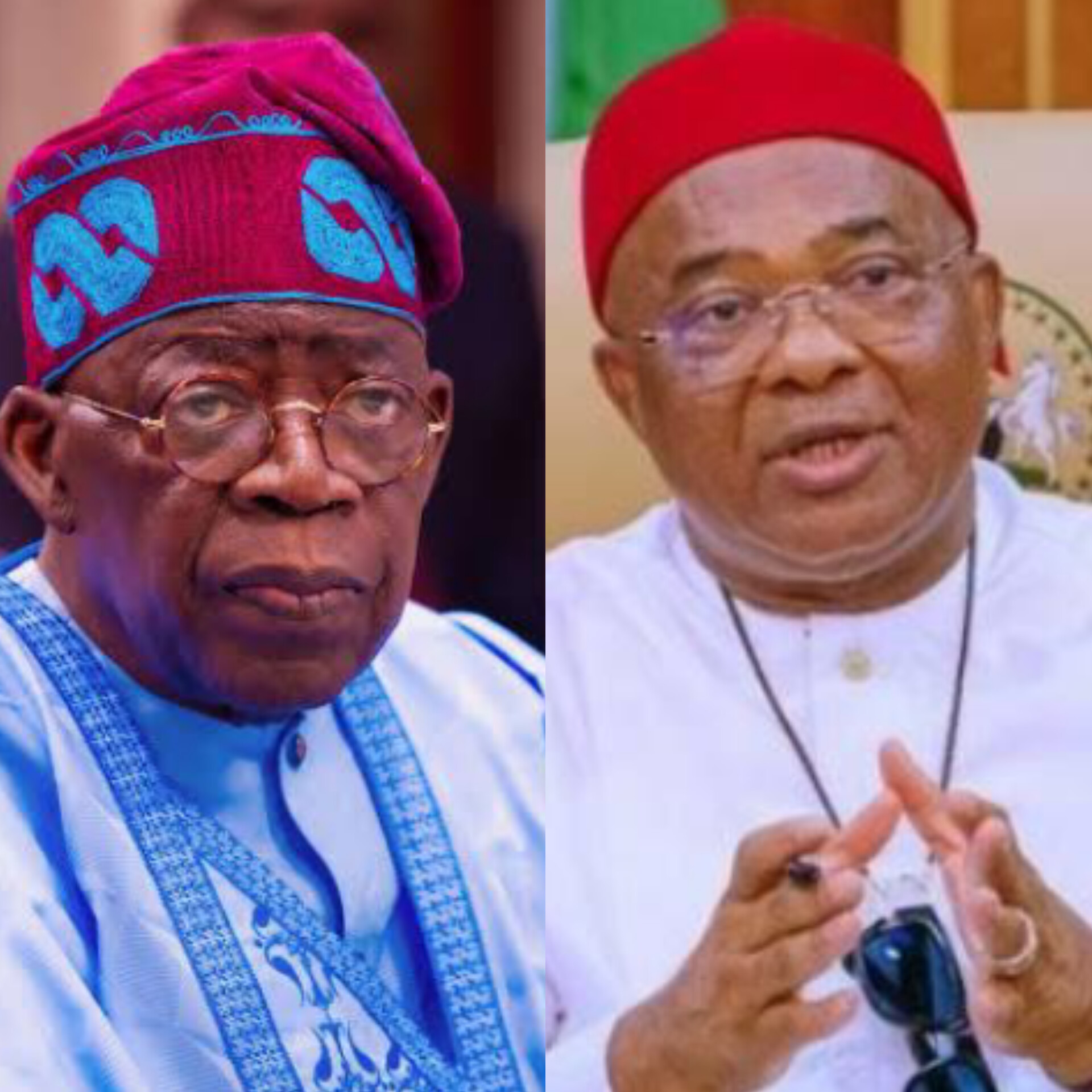
A combo of Presidrnt BolaTinubu and Governor Hope Uzodinma Photo: Inshot
As Nigeria approaches the 2027 general elections and President Bola Tinubu prepares for the much-awaited presidential election with other contenders, the All Progressives Congress (APC) faces a defining political test: consolidating its national structure, expanding its coalition of political interests and demonstrating that its record in government justifies a renewed mandate from the Nigerian electorate. Beyond the familiar calculations of campaign machinery, party structures and electoral arithmetic, the ruling party must navigate a more complex landscape shaped by economic reforms, regional interests, shifting political loyalties and public expectations of effective governance. Within this unfolding equation, Imo State Governor Hope Uzodinma occupies a position of considerable strategic importance, particularly in the South-East, where the APC continues to pursue broader political acceptance and a stronger electoral foothold.
Uzodinma’s significance derives from the convergence of his responsibilities as governor, his leadership position within the Progressive Governors’ Forum (PGF) and his appointment by President Bola Ahmed Tinubu as Director-General of the Renewed Hope Ambassadors. These roles place him at an important intersection of state administration, party coordination and national political mobilisation. They also present him with an opportunity to strengthen the relationship between the Presidency, APC governors and political stakeholders across the federation as the party prepares for another demanding electoral contest.
Yet, it is in the South-East that Uzodinma’s political relevance acquires its most distinctive character. Among his supporters, he is increasingly portrayed as the “Last Man Standing” for the APC in the South-East— a description that captures their perception of his importance as a prominent governor from the region who has remained within the ruling party and continues to champion its political interests. The expression is more than a slogan of political loyalty; it reflects the strategic value supporters attach to maintaining an established APC presence in a region where the party faces the challenge of broadening its appeal, building stronger alliances and demonstrating the practical benefits of participation in national governance.
The “Last Man Standing” premise therefore provides a useful lens through which to examine Uzodinma’s place in the APC’s evolving political strategy. It speaks to the significance of political steadfastness, the capacity to sustain party structures in a challenging environment and the responsibility of translating an individual political foothold into a wider regional coalition. Whether this position can become the foundation for a more expansive APC presence in the South-East will depend on Uzodinma’s ability to combine political leadership with credible engagement, inclusive development and effective mobilisation.
The South-East Political Equation: From Political Survival to Regional Influence
The South-East occupies a distinctive place in Nigeria’s political landscape. Its commercial networks, entrepreneurial culture, human capital and historical experience give the region considerable national importance. Nevertheless, the APC’s efforts to establish a more substantial political presence there have encountered the challenge of building trust, sustaining relationships and persuading voters that the party’s national platform can adequately accommodate regional aspirations.
In this context, Uzodinma’s continued prominence within the APC provides the party with an established point of political engagement. His governorship gives him an executive platform, while his relationships within the ruling party provide channels through which regional concerns can be communicated to the Presidency and other national institutions. His role is consequently not limited to preserving the APC’s political position in Imo State; it also encompasses the broader task of helping the party develop relationships capable of extending its influence across the South-East.
Supporters of the governor point to his political management and relationship with President Tinubu as evidence of his ability to attract attention to the region’s interests. Some also attribute the growing willingness of political actors from the South-East and South-South to engage more closely with the APC to Uzodinma’s leadership and advocacy. This interpretation underscores the importance they attach to his political style, which they regard as an instrument for opening channels of communication, building confidence and encouraging cooperation across established political boundaries.
Such claims should, however, be distinguished from independently established explanations for the political choices of individual governors. Political realignments generally arise from a combination of considerations, including relationships with national leaders, electoral calculations, party interests, policy expectations and assessments of future political opportunities. Uzodimma’s influence may contribute to these developments, but the decisions of other political actors must ultimately be understood in their own contexts.
What is beyond dispute as a matter of political strategy is that a prominent APC governor from the South-East can serve as an important bridge between the region and the federal centre. His capacity to sustain that role will depend on the strength of his relationships, the credibility of his engagement and the extent to which those relationships advance objectives that matter to the people he represents.
The challenge, therefore, is to transform the “Last Man Standing” narrative from a declaration of political survival into a broader programme of regional inclusion. Remaining within a political party can preserve a foothold, but expanding its influence requires the ability to persuade other political leaders and ordinary citizens that the party offers a credible platform for addressing their concerns.
Uzodimma and the Expansion of the APC’s Political Coalition
One of the central requirements of electoral success is the capacity to build and maintain a coalition broad enough to accommodate different interests without sacrificing organisational coherence. President Tinubu’s re-election ambitions will depend substantially on the APC’s ability to retain its established constituencies, strengthen relationships with state-level political leaders and attract additional support across the country.
Uzodinma’s position within the ruling party provides him with an opportunity to contribute to this process. As chairman of the Progressive Governors’ Forum, he occupies a platform for engagement among the APC governors, while his responsibilities as Director-General of the Renewed Hope Ambassadors place him within the party’s wider mobilisation and communication framework. Together, these positions give him access to important political networks through which the APC can coordinate its message, discuss strategic priorities and engage stakeholders whose cooperation may prove significant in 2027.
The Imo Governor’s potential contribution is especially relevant in regions where the APC is seeking to consolidate its presence or broaden its electoral reach. His experience in party politics and executive administration may help facilitate conversations among political leaders, encourage constructive dialogue and create opportunities for alliances that serve both national and regional interests.
If these efforts lead to confirmed defections by governors, legislators or other influential political figures, the APC could gain additional organisational strength and widen the network of political relationships supporting Tinubu’s re-election bid. Such developments could also improve the party’s access to local political structures and expand its capacity to communicate with constituencies beyond its traditional strongholds.
However, the distinction between political consultation, expressions of interest and formal party defection remains essential. Meetings between political leaders do not, by themselves, establish that a decision to change party affiliation has been made. Any claim that a governor or prominent political figure has joined the APC should be supported by a formal announcement or other reliable confirmation.
The more enduring measure of Uzodinma’s influence will therefore not be the number of speculative defections attributed to his efforts, but the extent to which his political engagement produces sustainable relationships, credible commitments and effective cooperation. A coalition built on shared objectives and public confidence is more likely to endure than one sustained primarily by short-term electoral calculations.
For Tinubu, such a coalition could strengthen the APC’s national position. For Uzodinma, it would reinforce his standing as a political intermediary capable of connecting regional actors with the national leadership. For the South-East, the value of these relationships would ultimately depend on whether they help advance the region’s development priorities.
From the 3R Agenda to the National Development Conversation
Uzodinma’s political standing cannot be separated entirely from his performance as governor. His administration’s Reconstruction, Rehabilitation and Recovery agenda, popularly known as the ‘3R mantra’ , provides the principal framework through which it has presented its efforts to rebuild infrastructure, improve public services and stimulate economic activity in Imo State.
Among the projects associated with the administration are interventions on the Owerri–Okigwe Road and Owerri–Orlu Road, as well as the Assumpta twin flyovers in Owerri, which President Tinubu commissioned on September 30, 2025. These projects illustrate the importance the administration attaches to road infrastructure and urban mobility.
Roads are fundamental to economic activity because they connect communities, markets, agricultural producers, businesses and public institutions. Where they are properly constructed and maintained, they can reduce transport difficulties, improve access to essential services and facilitate the movement of goods and people. Their developmental value, however, must ultimately be assessed through their durability, accessibility and contribution to economic productivity.
The same considerations apply to Uzodinma’s human capital initiatives. Through SkillUp Imo, his administration has pursued digital-skills training intended to prepare young people for opportunities in an increasingly technology-driven economy. The programme reflects an understanding that sustainable development requires more than physical infrastructure; it also requires people equipped to participate in emerging industries, establish businesses and contribute to higher productivity.
Similarly, the ANOH Gas Plant, which recorded first gas in January 2026, represents an important milestone in the wider development of the gas industry and its potential contribution to economic activity in Imo State. The benefits of energy investment can extend into industrial production, employment and supporting services, although the extent of those benefits depends on the connections established between major projects and the wider economy.
These initiatives are relevant to the national political conversation because voters increasingly evaluate governments through the opportunities and services available to them. The APC’s case for continued national leadership will be stronger if its state governments can demonstrate verifiable improvements in infrastructure, employment, education, healthcare and economic opportunity.
For Uzodinma, this creates a relationship between his responsibilities in Imo and his contribution to the party’s national political ambitions. His administration’s record provides a basis for explaining the development priorities pursued by an APC government, while his national political position offers a platform for advocating greater cooperation between the federal and state governments.
The essential requirement is that political communication remains grounded in evidence. Completed projects, ongoing initiatives and proposed programmes should be clearly distinguished, and claims of success should be supported by outcomes that citizens can assess. Such discipline strengthens public confidence and ensures that the party’s development narrative is not reduced to political promotion.
The Renewed Hope Ambassadors and the Task of Political Communication
President Tinubu’s appointment of Uzodinma as Director-General of the Renewed Hope Ambassadors has added a significant dimension to his national political responsibilities. The assignment places him within a structure intended to promote engagement around the administration’s policies and achievements, making his role particularly relevant as the APC prepares for the 2027 election.
Political communication is an important component of democratic governance. Governments must explain the objectives of their policies, communicate implementation progress and help citizens understand the implications of major decisions. In a period of economic adjustment, this responsibility becomes even more consequential because public perceptions are influenced by the immediate costs of reforms as well as expectations of future benefits.
Nigeria’s economic reforms, including changes to fuel subsidy arrangements and foreign-exchange management, have generated significant pressures for households and businesses. The long-term justification for these measures depends on whether they contribute to economic stability, productive investment, stronger public finances and improved living standards. Citizens will ultimately assess their value through practical outcomes, including purchasing power, employment opportunities, business performance and access to essential services.
The Renewed Hope Ambassadors therefore face a responsibility that extends beyond the repetition of government talking points. Effective engagement must combine accurate information, clear explanations and responsiveness to legitimate public concerns. It should acknowledge the difficulties associated with implementation while presenting evidence of progress where such evidence exists.
Uzodinma’s leadership could be valuable in coordinating this process across political networks and helping the APC communicate its national agenda in a manner that reflects the experiences of different communities. In the South-East, especially, the task will involve demonstrating how federal policies and development investments relate to regional priorities.
If the party hopes to broaden its appeal, it must recognise that political loyalty cannot be assumed and that citizens are entitled to evaluate the performance of government independently. The strongest case for re-election will be one in which the administration’s objectives, implementation record and measurable outcomes can withstand public scrutiny.
The South-East’s Development Priorities and the Politics of Inclusion
For the APC to make significant political gains in the South-East, its engagement with the region must be supported by a credible development agenda. Infrastructure, electricity, industrial growth, healthcare, education and access to investment remain important considerations in determining the region’s economic future.
Improved transport connectivity can strengthen commercial links between the South-East and other parts of the federation. More reliable electricity can support manufacturing, small businesses and other productive activities. Investment in industrial infrastructure can create employment, while improvements in education and healthcare can enhance human capital and household welfare.
These objectives require cooperation across federal, state and local governments, alongside sustained engagement with the private sector, professional organisations, community institutions and other stakeholders. No single political office holder can deliver all the required changes independently, but effective political leadership can help establish the relationships through which coordinated action becomes possible.
Uzodinma’s proximity to the Presidency and his standing within the APC provide an opportunity to advance these concerns in national discussions. He can use his relationships to advocate for infrastructure investment, encourage policy coordination and strengthen communication between the federal government and regional stakeholders.
This is where the “Last Man Standing” premise can acquire a deeper meaning. Rather than treating his continued presence in the APC solely as evidence of partisan loyalty, supporters can frame it as an opportunity to make a stronger case for regional inclusion within the national political system. The strategic question is not simply whether the APC can retain a prominent governor in the South-East, but whether that presence can help secure policies and investments that improve the lives of people across the region.
Political alliances will be more sustainable when they are accompanied by evidence that participation in the national governing coalition offers practical opportunities for development. Conversely, if citizens perceive that regional concerns remain inadequately addressed, the presence of influential political leaders within the ruling party may not automatically translate into wider electoral support.
The APC’s challenge is therefore to combine political organisation with a credible programme of inclusion. Uzodinma has the capacity to contribute to that effort, but its success will depend on the willingness of the relevant institutions to respond to regional priorities and on the ability of government at every level to deliver results.
Political Experience and the Road to 2027
Uzodinma’s experience in the Senate before becoming governor provides another dimension to his political profile. Having represented Imo West in the National Assembly for two terms, he is familiar with legislative processes, federal policymaking and the relationship between the executive and legislative branches of government.
That experience may inform his approach to issues such as fiscal federalism, infrastructure financing, energy policy and institutional reform. It also gives him an understanding of the practical challenges involved in translating political decisions into programmes that produce measurable results.
Speculation about a possible return to the Senate has featured in discussions of his future political options, but such a prospect should be treated as unconfirmed unless formally established. His immediate responsibilities remain those associated with the governorship and his current roles within the APC.
The more pressing issue is how effectively he can balance state administration with the demands of national political mobilisation. His ability to build alliances and contribute to Tinubu’s re-election project will be important, but those responsibilities cannot displace the obligation to sustain development in Imo State.
A governor’s legacy is shaped not merely by the political offices occupied or the relationships cultivated, but by the condition of public infrastructure, the quality of public institutions, the opportunities available to young people and the effectiveness of services delivered to citizens. It is certain that Uzodinma’s political influence will carry greater weight if it is matched by a development record that withstands scrutiny.
The Last Man Standing Must Become the Bridge to a Wider Coalition
As the 2027 general elections are fast approaching , Hope Uzodinma stands at an important intersection of Imo State governance, APC political coordination and the party’s efforts to strengthen its position across the South-East. His supporters’ description of him as the “Last Man Standing” for the APC in the region captures the symbolic and strategic importance they attach to his continued presence in the ruling party. It also raises a more consequential question: can that position become the foundation for a wider political coalition capable of advancing both the APC’s electoral interests and the region’s development aspirations?
The opportunity is substantial. As chairman of the Progressive Governors’ Forum and Director-General of the Renewed Hope Ambassadors, Uzodinma is positioned to facilitate dialogue among political leaders, support the communication of federal policies and encourage cooperation between the Presidency and state-level stakeholders. His political experience and relationships may help the APC broaden its engagement with influential actors in the South-East and beyond.
Nevertheless, political influence must be translated into outcomes. If his efforts contribute to confirmed defections or stronger alliances, those developments could improve the APC’s organisational position ahead of 2027. But electoral strength will ultimately depend on the party’s ability to demonstrate that its policies address the concerns of ordinary Nigerians and that its governments are delivering measurable improvements in public welfare.
For the South-East, the test will be whether political engagement produces tangible progress in infrastructure, electricity, industrial development, healthcare, education and employment. For Imo State, it will be whether the 3R agenda continues to generate sustainable benefits. For President Tinubu, it will be whether the national reform programme can earn sufficient public confidence to justify a renewed mandate.
Uzodinma’s enduring significance may therefore lie in his ability to connect these different responsibilities. He has the opportunity to serve as a bridge between the Presidency and regional political stakeholders, between party organisation and public engagement, and between political loyalty and the pursuit of development.
The “Last Man Standing” narrative is most compelling when understood not as an end in itself but as a starting point for a larger political and developmental mission. Remaining standing within a party may preserve its foothold in a challenging political environment; building bridges can expand that foothold; and delivering results can give the resulting coalition lasting credibility.
Ultimately, the success of Tinubu’s re-election project will depend on more than the strength of political alliances or the influence of individual governors. It will depend on the relationship between public policy and public welfare, between political promises and measurable performance, and between national leadership and the aspirations of Nigeria’s diverse regions.
For Uzodinma, the challenge is to ensure that his standing within the APC becomes more than a symbol of political endurance. It must become an instrument for effective governance, regional inclusion and national development. That is how the “Last Man Standing” can become a bridge to a stronger political coalition—and how political influence can be transformed into a lasting record of public service.
Thomas, a public affairs analyst and commentator, contributes this piece from Lagos