
Book Review
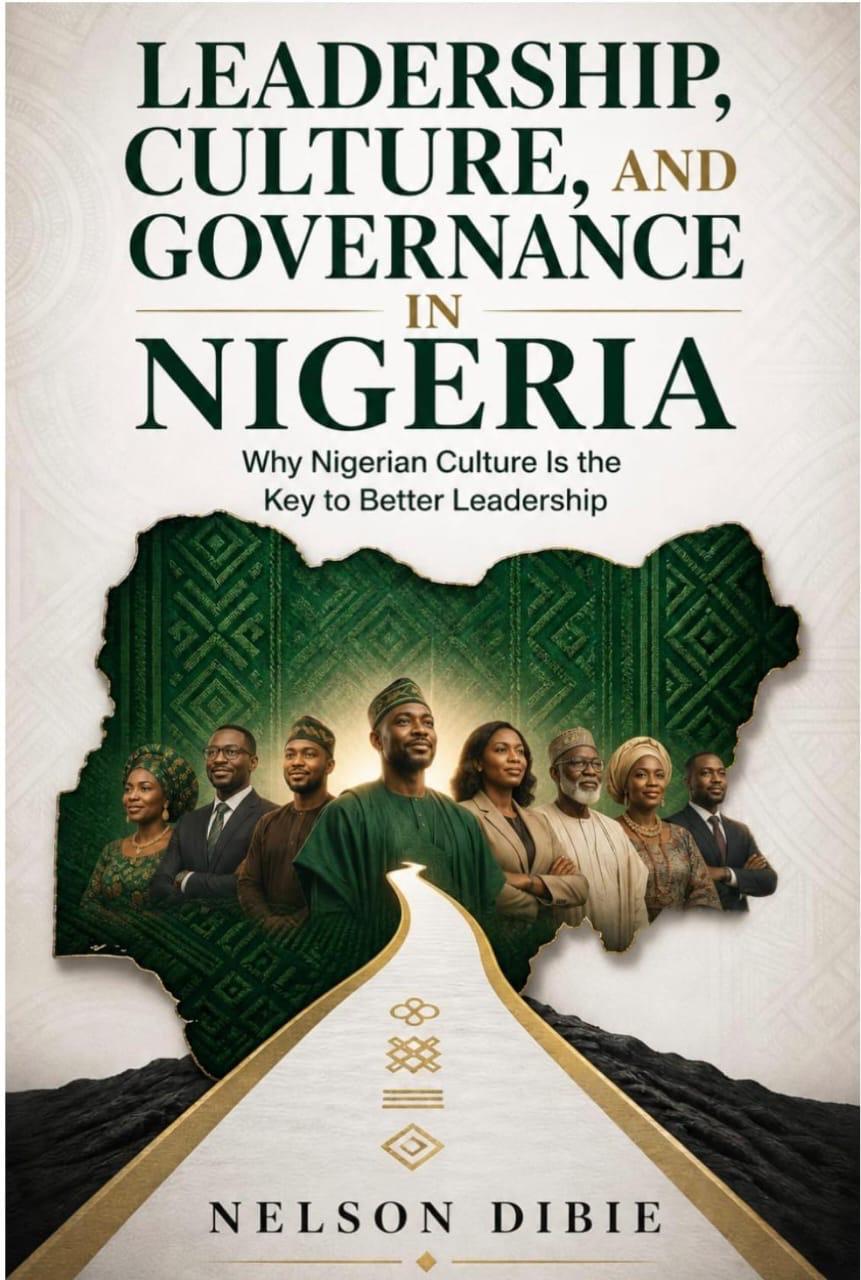
Leadership, Culture, and Governance in Nigeria: Understanding the Country Through Its Culture
Nigeria has spent decades searching for the right political leadership, institutional framework and governance model to unlock its development potential. Yet, despite successive administrations, constitutional reforms and numerous policy interventions, many of the country’s fundamental governance challenges remain unresolved.
Could part of the problem lie beyond the institutions themselves, in the cultural values, social expectations and behavioural patterns that shape how Nigerians exercise authority, relate to one another and respond to public responsibilities?
This is the intriguing question at the heart of Leadership, Culture, and Governance in Nigeria: Understanding the Country Through Its Culture, a thought-provoking publication by Nigerian-born scholar and leadership expert, Dr. Nelson Dibie.
Rather than approaching Nigeria’s governance crisis strictly as a political or administrative problem, Dibie introduces a broader perspective: the relationship between culture and the quality of leadership and governance.
His central argument invites readers to reconsider an often-overlooked dimension of national development — that institutions do not operate in isolation from society. They are influenced, sustained and sometimes weakened by the values and behaviours of the people who occupy them.
When Cultural Values Shape Public Leadership
One of the book’s most interesting contributions is its examination of the influence of family obligations, communal relationships, social networks and traditional expectations on leadership decisions.
In Nigerian society, loyalty to family, community and ethnic identity remains an important cultural consideration. These relationships can strengthen social solidarity and collective responsibility. However, problems arise when personal obligations begin to override merit, institutional procedures, transparency and the wider public interest.
Dibie’s analysis presents an important distinction between preserving cultural identity and allowing certain cultural practices to undermine institutional integrity.
His argument is particularly relevant in a country where public appointments, political patronage, resource allocation and accountability frequently generate debates about the relationship between personal loyalty and national responsibility.
Reframing the Corruption Debate
The book also offers a broader perspective on corruption, moving beyond the tendency to treat it exclusively as the consequence of individual greed or moral weakness.
Dibie examines the cultural and institutional environments that allow unethical conduct to become tolerated, normalised or even defended within certain social settings.
This perspective raises an important question: can a society successfully fight corruption when its everyday attitudes and social expectations sometimes accommodate the very practices its laws prohibit?
For Dibie, sustainable reform requires more than legislation, law enforcement and punishment. It must also involve ethical leadership, civic education, responsible citizenship and institutions capable of enforcing accountability without fear or favour.
The implication is significant: the fight against corruption must be both institutional and cultural.
A Nigerian Perspective Informed by Global Experience
The intellectual value of Dibie’s argument is reinforced by his personal and professional journey.
Born in Kwale, Delta State, he began his education at Army Children School and Bishop Phillips Academy, Ibadan, before proceeding to Federal Polytechnic, Oko, where he obtained his OND and HND qualifications.
Following his National Youth Service, he relocated to the United States, earning degrees in Mass Communication and Public Administration before obtaining a doctorate in Management and Leadership.
His professional experience spans human resources management, organisational development and institutional leadership. He has held senior positions at Delaware North and Chicken Ranch Casino and served as Chief People and Culture Officer at Fresno Economic Opportunities Commission (Fresno EOC), one of the largest community action agencies in the United States.
He is also an Adjunct Professor at Fresno Pacific University, where he teaches postgraduate courses in leadership, organisational ethics, conflict management, negotiation and organisational behaviour.
This combination of Nigerian cultural experience, international academic exposure and practical organisational leadership gives his examination of governance a distinctive dimension.
Rather than viewing Nigeria’s challenges exclusively through imported governance theories, Dibie encourages a closer examination of the cultural realities within which Nigerian institutions function.
From Leadership as Position to Leadership as Responsibility
Another important dimension of the book is its underlying philosophy of leadership.
For Dibie, leadership should not be measured merely by the authority an individual exercises or the position occupied. Its real value lies in service, integrity, accountability, empowerment and the ability to create conditions for people and institutions to succeed.
This understanding challenges the conventional perception of leadership as an avenue for personal advancement and reinforces the idea that public authority carries an obligation to serve the collective interest.
His professional recognition, including Leadership of the Year in 2024, and his involvement in designing and launching the Fresno EOC Leadership Academy reflect his commitment to leadership development.
An ordained associate minister and active community mentor, Dibie also brings a personal appreciation of ethical responsibility and human development to his leadership philosophy.
The Bigger Question: What Kind of Society Is Nigeria Building?
Perhaps the most important contribution of Leadership, Culture, and Governance in Nigeria is the conversation it opens about the kind of society Nigerians wish to build.
It challenges the assumption that replacing political officeholders or restructuring government institutions will, by themselves, produce meaningful transformation.
A country cannot sustainably achieve good governance if its citizens demand accountability from public officials but tolerate dishonesty in their private dealings, celebrate connections over competence or place personal and communal interests above the common good.
Equally, cultural diversity should not be treated as a liability. Nigeria’s different traditions, values and social structures can provide a strong foundation for national development when guided by shared principles of justice, fairness, integrity and mutual responsibility.
Ultimately, Dibie’s work makes a compelling case for a more comprehensive understanding of national transformation — one that recognises the connection between the character of citizens, the conduct of leaders and the strength of institutions.
For policymakers, academics, public administrators, students and Nigerians concerned about the country’s development trajectory, the book offers an important perspective.
Its enduring message is that Nigeria’s governance challenge is not simply about who occupies public office or what policies government adopts. It is also about the values that inform decisions, the behaviours society rewards and the standards citizens are prepared to uphold.
The journey towards good governance may therefore require Nigeria to reform not only its institutions but also the cultural attitudes through which those institutions are shaped and sustained.