

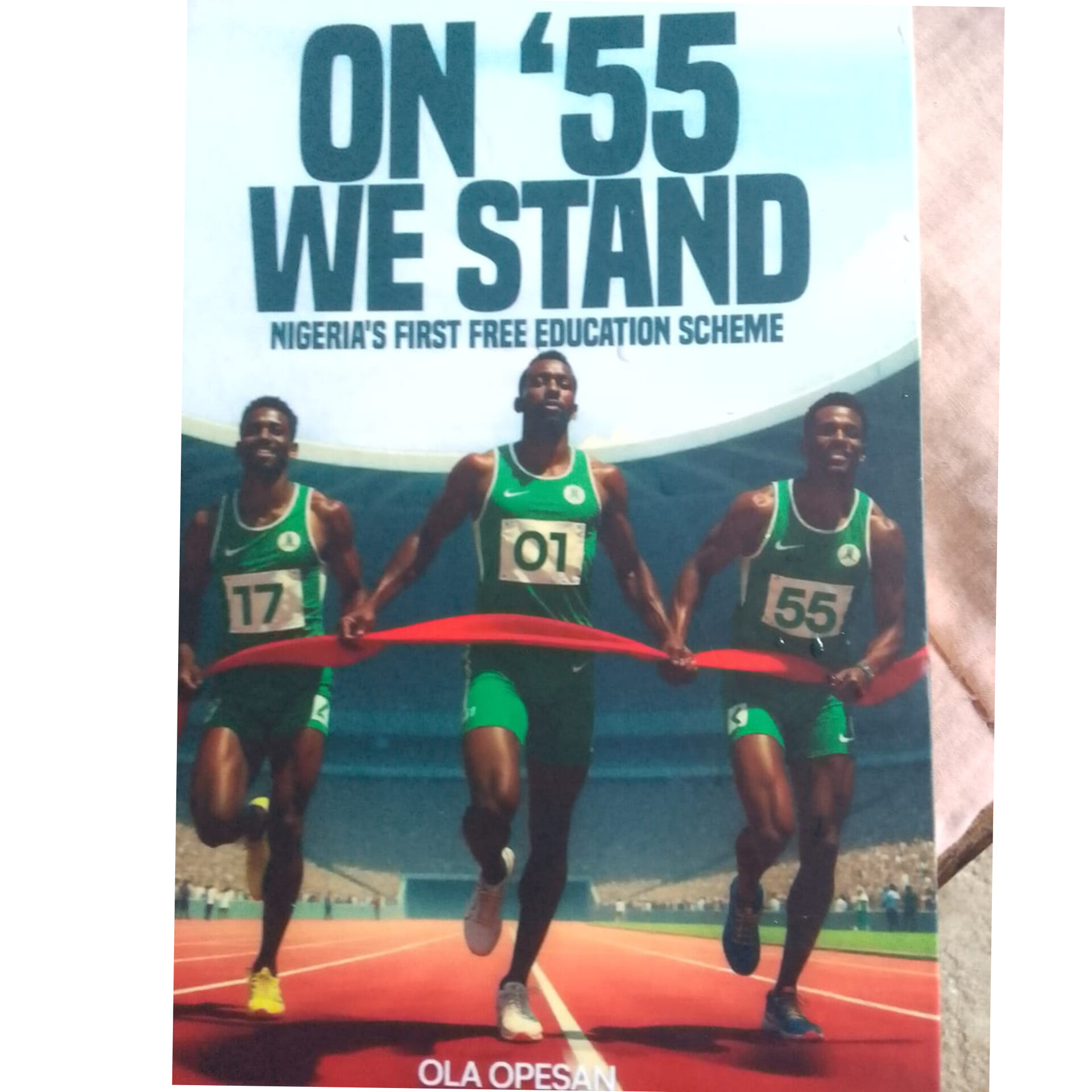
Front page of ‘ON ’55 WE STAND’
Title: ON ’55 WE STAND
NIGERIA’S FIRST FREE EDUCATION SCHEME
Author: Ola Opesan
Publishers: RONU BOOKS
Pagination: 215
Year of Publication: 2025
Reviewer : Adebayo Obajemu
Ola Opesan is an engaging writer with eclectic taste, and his wide range of taste and display of intellect in all his works have marked him out as a polymath rare in our clime. A mathematics teacher, with a Master degree in mass communication , he has also shown uncanny interest and ability in other disciplines; little wonder he brings a lot of profundity and scholarship into his account of the Universal Free Education programme of the Chief Obafemi Awolowo administration during his days as Premier of the Western Region in the 50s.
Opesan’s latest book: ON ’55 WE STAND is a seminal account of the free education program of Awo administration in the 50s, a massive educational experiment started in April 1955, which today has stood out as the most successful of all education initiatives in Africa.
The book is compartmentalised into 10 chapters. The first chapter delves into the nature of what constitutes education at the levels of both formal and informal .
With a brilliant panache ,the book takes a survey of the trajectory of education in the country, beginning with 1925 Colonial Memorandum on Education for the British Colonial Territories which framed and shaped the country’s educational policy from 1925 to 1945.
This nuanced and well researched survey – detailed and comprehensive gives account of the contributions of both Christian and Islamic missions to Education in the country. These contributions are loud as can be seen in the establishment of important missions schools , institutions that produced and still produce crop of eminent Nigerians that formed the nation’s intelligentsia in politics, the military, business and every segment of life.
The influence and contributions of important educators like Mary Slessor, Birch Freeman, James Kwegyr Aggrey, Oludotun Ransome-Kuti, Alvan Ikoku and others are highlighted.
In chapter 2 , Opesan looks at the state of education in the time of constitutional change in Nigeria, the policies and how these unsettled nationalists like Awolowo who yearned for holistic education for the masses in a way that can drive development agenda for a nation on the threshold of self rule… As expected, this period marked a turning point in the gradual evolution of Nigeria, the development of nationalism, the Richard and MacPherson constitutions and regionalism. This hyper activity towards self rule fired the need for education that will move away from colonial concept to nationalists’ demand for a catholic education that would equip Nigerians with knowledge and understanding required of a nation nearing independence.
Here, we encounter Chief Obafemi Awolowo’s vision for Universal Primary Education, including the nucleus of its fanatical drivers like Chief Michael Ajasin, Canon S.A. Adeyefa, T.T.Solarun, Chief ( later Prof.) S.O. Awokoya and Archdeacon Emmanuel Alayande.
Chapter 3 gives an account of the pervasive consultations with critical stakeholders- and mass mobilisation that preceded the formal launch in 1955. The iconic Awo’s meeting with the Deji of Akure, where the Deji – in site of belonging to different political tendency – gave Awo his support after listening to the sage’s presentation and assurances that taxation would be judiciously used to fund the program.
The capitation taxation to be levied to fund the free education became a subject of political dispute among contending political parties, and was weaponised by the opposition to advantage .
In the federal election of 1953, the opposition NCNC won 53 as against the Action Group 35 percent of the votes. If it had been an election to the regional House of Assembly, the AG would have been kicked out of office, and the Universal Primary Education programme would have remained a mirage.
The following chapter captures the key drivers of the important initiative – Awo, Ajasin, Awokoya, Alayande and others, and the sacrifices they made even in the face of stiff opposition. The dramatis personae that drove the initiative, the trajectory of their lives, the impulses and the various influences that fired their imagination are captured vividly by the author.
In chapter 5 tagged: E-Day, Opesan presents a panoramic picture of the prelaunch media blitz, the frenzy , fears , apprehension and subdued excitement about the new experiment.The festivities that ushered in the scheme on E-Day was palpable.
The scheme was introduced on January 17, 1955 and the Day was characterized by parades and speeches by Chief Obafemi Awolowo , the Premier and Chief S O. Awokoya, the man in charge of education.
About 13,350 teachers were pencilled down to kickstart the program in 1955 to cater for about 400,000 pupils in Western Nigeria. The expected trend was to reach the target of 21,350 teachers by 1961, according to Awokoya.
Chapters 6-10 are a detailed analysis, commentary on and exposition of Universal Primary Education in practice in Western Region, the successes and challenges, the impact of UPE on the development of intellectual manpower in Western Region, and how this experiment catapulted the West ahead of other regions in terms of development, school enrollment, the numbers of schools established and other opportunities.
The West’s headstart in education today is traced to this noble experiment which has become a reference point for policy success.
The author interviewed some of the early beneficiaries of the scheme ,as they in turn, offered interesting insight into how the 1955 scheme radically changed the fortune of Western Nigeria.
The military interventions in the affairs of the young nation halted the noble scheme as the country was brutally brought under unitary arrangements by the military who presided over the affairs of the country from 1966 to 1979.
The author takes a hard look at this development as a major setback for the noble education initiative. The military itself attempted a copycat of the scheme in 1976 during the administration of General Olusegun Obasanjo without really fully understanding the dynamic and logic of it. Their own experiment collapsed like a pack of cards in 1978 under the weight of dwindling resources. Part of the fallout of the military abandonment of the scheme was the famous ” Ali Must Go” riots when university students protested against increase in accomodation and feeding fees , even when the government claimed it had made tuition free.
When the country was returned to civil rule in 1979 President Shehu Shagari who came to power cancelled the scheme.
Opesan’s book interrogated a lot of challenges in education sector, presenting insight of leading educationists like Tai Solarin, Professor Babs Fafunwa and others.
The book looks at trajectory of education policies post civil war up to the present, tracing the compounding of the problems in the sector to a lack of adequate understanding of the challenges, commitment deficit and poor planning amidst policy inconsistency, the dissonance between policy and practical needs of a country yearning for technological and scientific advancement.
The book is a must read for policy makers, stakeholders, students, and all those interested in education as a tool of national development.
Opesan’s outing in this important work is not all that there is about him.
He has previously acquainted himself as writer, journalist and educationist. His first literary outing was the novel: Another Lonely Londoner (1991), under the pen name Gbenga Agbenugba.
He was born in London to Nigerian parents in 1966. He returned with his family to Nigeria when he was ten years old, going to school there, and attending the University of Ife. He returned to London to study scriptwriting, completing a TV and video course, and writing several screenplays.
While in London Opesan read Sam Selvon’s novel The Lonely Londoners, and in response wrote his own novel, Another Lonely Londoner. Written in a mix of English and Nigerian pidgin, the novel deals with the experience of young Nigerians in London. Alienated as an immigrant by his encounter with British racism, the novel’s protagonist Akin eventually decides to return to Nigeria:
He had spent the greater part of his life in London, and he had come to realise that though the colour of him passport blue, the colour of him skin tell him, he had no choice about where was home.
In 1996-7 Opesan was editor of the Nigerian lifestyle magazine Ovation. In 1997 he published his second novel, Many Rivers to Cross, under his own name. In 1999 he became the editor of another lifestyle magazine, Omega. He also contributed an essay on African businesses in the UK to the 2000 Penguin anthology IC3.
Opesan gained a BA in Business Studies from the University of East London and a MA in Mass Communications from the University of Leicester before training as a secondary school maths teacher. He became head of mathematics and later assistant head teacher at George Mitchell School in Leyton. In 2007 he moved to Lagos as the founding Principal of Meadow Hall School, Lekki, Lagos. There he has also authored an introductory book about Nigerian history.
Opesan’s wide interest encompassing many fields and his engaging prose have defined him as a polymath with self -effacing nature.

