
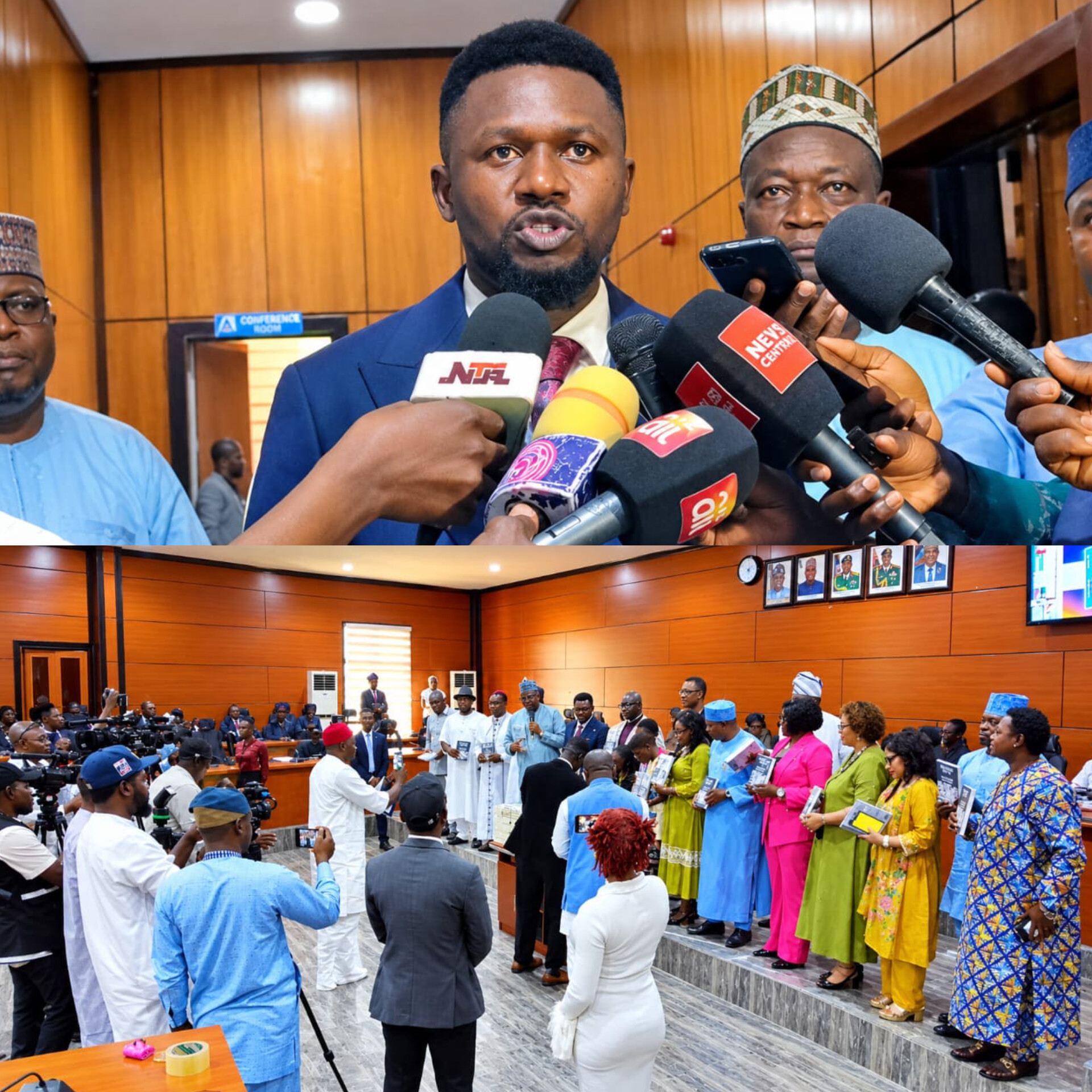
A combo of Dr Sunday Isuwa and guests at the event Photo: Inshot
By Our Reporter
Kaduna State Governor, Uba Sani; the Group News Editor of LEADERSHIP Newspaper, Dr Sunday Isuwa; and the President of Vision Africa, Archbishop Dr Sunday Onuoha, have warned that misinformation, deepfakes, artificial intelligence and shrinking newsrooms pose significant threats to journalism and Nigeria’s democratic process ahead of the 2027 general election.
They spoke at the launch of Isuwa’s book, Digital Shift in Nigeria’s Newspaper Industry, held at the Army Resource Centre, Abuja, where they called on journalists and media organisations to strengthen fact-checking, uphold editorial independence and adapt to technological changes without compromising professional ethics.
Sani, who was represented by the Kaduna State Commissioner for Information, Ahmed Maiyaki, warned that artificial intelligence and shrinking newsrooms were creating significant challenges for journalists, urging media practitioners to acquire new skills to remain relevant in the evolving media landscape.
Maiyaki said technological advancements were reshaping newsroom operations, reducing production teams and increasing the responsibilities of individual journalists.
He noted that journalists in some international media organisations were increasingly expected to perform multiple roles, including reporting, filming and producing video content.
The commissioner urged Nigerian journalists to embrace emerging technologies, improve their professional skills and adopt innovative approaches to news production to remain competitive.
“Journalists and media organisations must also improve their skills and embrace new approaches to news production,” he said.
He expressed concern that artificial intelligence was affecting employment across creative industries, including journalism, and stressed the need for practitioners to understand the technology and prepare for its implications.
Maiyaki also warned against misinformation and manipulated content as Nigeria prepares for the 2027 general elections.
He recalled that fabricated recordings and synthetic voices had featured in political discourse during previous election cycles, stressing that journalists must go beyond reporting events to investigate claims and verify information.
The commissioner said responsible journalism remained essential to protecting democracy, promoting national unity and maintaining stability.
“Campaigns will end, posters will disappear, and some candidates will win while others will lose. But the most important thing is the survival, unity and progress of Nigeria,” he said.
He commended Isuwa for examining the transformation of the newspaper industry and its implications for the future of journalism.
Maiyaki also announced a donation of N1m towards the purchase of two copies of the book in support of the author’s work.
Speaking at the event, Isuwa, who is also the Chairman/Publisher of Elanza News, said digital technology had transformed how news was produced, distributed and consumed, enabling information to reach audiences within seconds through websites, social media and mobile platforms.
However, he noted that the transformation had created challenges, including misinformation, changing business models and increasing pressure on journalists to prioritise speed over accuracy.
“These changes matter to all of us, not just journalists and newspaper publishers. They matter to students learning to assess information, educators preparing the next generation, and every reader who wants to distinguish reliable reporting from misleading information,” he said.
The author stressed that technology alone could not guarantee quality journalism, adding that ethical practices, sound professional judgement and commitment to public service remained essential.
“Technology alone cannot guarantee good journalism. That still depends on ethical practices, sound professional judgement and a commitment to serving the public,” Isuwa said.
He called for sustained collaboration among journalists, educators, students and readers to ensure that technological advancement did not undermine the fundamental principles of journalism.
Isuwa also advocated improved media literacy to help citizens assess information critically and distinguish credible reports from misleading content, particularly as digital platforms continued to reshape public communication.
Presenting a paper titled The Media’s Crucial Role in the 2027 General Election: Navigating Truth and Trust, Onuoha, who was represented by the Methodist Bishop of Kubwa Diocese, Rt. Rev. Dr Frederick Onoja, warned that misinformation, political interference and economic pressures could undermine public confidence in the electoral process.
Onuoha, a former Senior Special Assistant to ex-President Olusegun Obasanjo on Privatisation and Executive Director of Nigeria Interfaith Action, said elections were not merely contests for political power but also battles over information, public confidence and the legitimacy of democratic institutions.
He said voters could make informed decisions only when they had access to reliable information about candidates, political parties, public policies, government performance and the electoral process.
The cleric noted that social media, digital influencers and artificial intelligence had transformed the information landscape, making it easier for false claims to spread before journalists could verify or debunk them.
He warned that manipulated videos, fabricated photographs, cloned voices and AI-generated content could be used to mislead voters, inflame ethnic and religious tensions and undermine confidence in election results.
“Journalists can no longer rely exclusively on traditional questions such as whether a photograph or video looks genuine,” Onuoha said, urging newsrooms to establish clear procedures for detecting and verifying deepfakes and other AI-generated content.
He advised journalists to investigate the origins of suspicious materials, identify their original sources and seek independent confirmation before publishing election-related claims.
Onuoha also called for stronger collaboration among media organisations, fact-checkers, researchers and civil society groups to counter misinformation, noting that no newsroom could independently track every false claim circulating online.
On editorial independence, he cautioned media owners against allowing political advertising and commercial interests to dictate news coverage.
He urged media owners to establish clear boundaries between business operations and editorial decisions, stressing that paid political content should not be presented as independent journalism.
According to him, the same professional standards should apply to the government, opposition parties, political candidates and other influential actors.
The cleric further warned that the pressure to break election news must not override the obligation to verify information, particularly reports concerning electoral violence, rigging allegations and election results.
He said inaccurate reports could trigger panic, damage reputations and erode public trust, urging journalists to distinguish verified facts from political opinions and unsubstantiated allegations while giving individuals and institutions accused of wrongdoing the opportunity to respond.
Onuoha also advocated clear guidelines for the use of artificial intelligence in news production, including verification and disclosure procedures, adding that media organisations must embrace technological innovation without abandoning professional ethics.
He said responsibility for credible elections extended beyond journalists to media owners, political actors, technology companies and citizens, urging all stakeholders to promote a more responsible information environment.
He added that the 2027 general election would test both Nigeria’s democratic institutions and the credibility of its media, urging journalists to remain committed to accuracy, accountability and the public interest.
In his remarks, Isuwa said his book was intended to contribute to discussions about the future of journalism in Nigeria and Africa, particularly among students, journalists, educators and media practitioners.
He called for partnerships to expand access to the publication and promote media literacy, especially in communities where access to media education remained limited.
The author thanked his family, colleagues, mentors, readers and other stakeholders in the media industry for supporting the publication, urging readers to engage with the book and share constructive feedback to advance journalism in Nigeria.