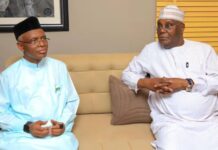

Rt. Hon. Mudashiru Obasa Photo credit: LSHA
By 2027, the contest for the Agege Federal Constituency seat in the House of Representatives may become less about political novelty and more about legislative Experience, institutional memory and influence within Nigeria’s evolving political architecture. Politics
At the centre of that conversation is the Speaker of the Lagos State House of Assembly, Rt. Hon. Mudashiru Obasa, whose decision to seek election to the Green Chamber has opened a fresh debate about what kind of representation communities such as Agege require in Abuja.
For supporters of the long-serving lawmaker, the argument is straightforward: in a parliament where seniority, committee influence and political networks often determine how quickly constituency interests are advanced, experience matters.
Few politicians seeking election to the House of Representatives in 2027 can point to a legislative résumé as extensive as Obasa’s.
Having entered elective politics as a councillor in Agege Local Government before moving to the Lagos State House of Assembly, he has represented Agege Constituency I for more than two decades and spent about 10 years as Speaker of Nigeria’s most influential state legislature.
He first became Speaker in June 2015, continued in 2019 and 2023 and returned to office in March 2025 after a brief political interruption, making him one of the longest-serving legislative leaders in Lagos history.
His emergence as the APC candidate for the Agege Federal Constituency seat ahead of the 2027 elections has therefore shifted political discussions beyond party calculations to questions about capacity and Experience.
Political observers note that leadership longevity in Lagos politics is rarely accidental.
The Lagos Assembly has over the years remained one of the country’s most active and visible sub-national legislatures, passing laws and engaging with successive administrations under governors from different political moments within the state’s ruling establishment.
Obasa’s tenure traversed the administrations of former Governor Akinwunmi Ambode and Governor Babajide Sanwo-Olu, periods marked by debates over transport reforms, urban renewal, taxation, housing, infrastructure and security policies.
For many within the political establishment, the fact that he retained the confidence of lawmakers across multiple assemblies speaks to his ability to navigate competing interests and sustain institutional stability.
Lagos-based political analyst, Amos Osagie, believes such longevity offers lessons in leadership.
“Remaining Speaker in Lagos for a decade requires more than political luck. It demands negotiation skills, relationship management and the ability to build consensus among lawmakers with diverse interests.”
According to him, those are precisely the qualities that prove valuable in the House of Representatives, where coalition-building and committee politics often shape legislative outcomes.
Another public affairs commentator, Yomi Obasola, sees the issue from a different angle.
“Whether people agree with him politically or not, Obasa’s supporters point to one fact that is difficult to ignore: institutional continuity in the Lagos Assembly under his leadership.”
Indeed, even the political turbulence that briefly disrupted his hold on the speakership in early 2025 culminated in his return to office, reinforcing perceptions of his enduring relevance in Lagos politics.
Beyond the legislative statistics, however, lies the more important political question: what does Agege stand to gain from sending a former Speaker to Abuja?
For residents interviewed across parts of the constituency, the answer frequently centres on access and influence.
At the bustling Dopemu market area, a trader, Alhaji Sulaimon Adebayo argues that representation in the National Assembly has evolved beyond attendance at plenary sessions.
“The House of Representatives is not a place to start learning politics from scratch. The people who get results are often those who understand the system and know how to navigate it.”
For him, legislative Experience can become a constituency asset.
Mrs Bose Tunji, who runs a private school in Agege, shares a similar perspective.
“People usually focus on projects, but relationships and influence are what attract opportunities to communities. A lawmaker who already has national visibility enters with an advantage.”
She believes the constituency’s growing population and infrastructure demands require a representative capable of operating effectively from day one.
Among younger residents, the argument is slightly different.
A youth leader in the constituency, who preferred anonymity due to the sensitivity of local political discussions, says many first-term lawmakers spend years learning parliamentary procedures before making a significant impact.
“Supporters believe Obasa would arrive in Abuja already familiar with legislative negotiations and committee work because he has spent years managing a parliament.”
That sentiment appears increasingly common among sections of the electorate who view parliamentary politics through the prism of influence rather than rhetoric.
Political scientist Dr Eddy Mensah notes that the National Assembly has gradually evolved into an institution where strategic positioning matters almost as much as constituency popularity.
“Experience translates into leverage. Former governors, former ministers and former speakers often arrive with networks that younger legislators take years to build.”
According to him, the transition from Speaker of the Lagos Assembly to the House of Representatives would represent a continuation rather than a reinvention of Obasa’s legislative career.
There is also the symbolism of the move itself.
After more than 23 years in the Lagos Assembly and six terms as a lawmaker, his decision to seek federal office marks the end of one political chapter and the beginning of another.
Supporters insist that Agege now has an opportunity to convert state-level political influence into stronger federal representation.
Critics, inevitably, will argue that longevity in office alone cannot become a substitute for performance and accountability.
That debate is likely to define the campaign season.
Yet even among political opponents, there is acknowledgement that Obasa enters the race with credentials that few candidates can match.
Councillor, state legislator, Speaker and parliamentary strategist are experiences rarely found in one political career.
As the countdown to 2027 gathers momentum, Agege voters may ultimately face a simple question.
In an era when legislative influence increasingly determines constituency outcomes, should representation be entrusted to fresh hands learning the ropes or to a politician whose supporters argue has spent decades mastering them?
For now, that question, more than campaign slogans or party banners, may define Agege’s political calculation.